01.07.2026

Patron Capital and INBRIGHT Portugal secure 15-year lease for 8,100 sqm with Portuguese public sector entity at Alto Business Park in Vila Franca de Xira

London/Lisbon, 01 July 2026 – Patron Capital, one of Europe’s leading value add and opportunistic real estate managers, and its partner INBRIGHT Portugal, the specialist light industrial and logistics investor, developer and asset manager, have signed a 15-year lease agreement with a Portuguese public sector entity at Alto Business Park in Vila Franca de Xira. The lease covers approximately 8,100 sqm of warehouse and office space within one of the most established light industrial submarkets in the Greater Lisbon area.
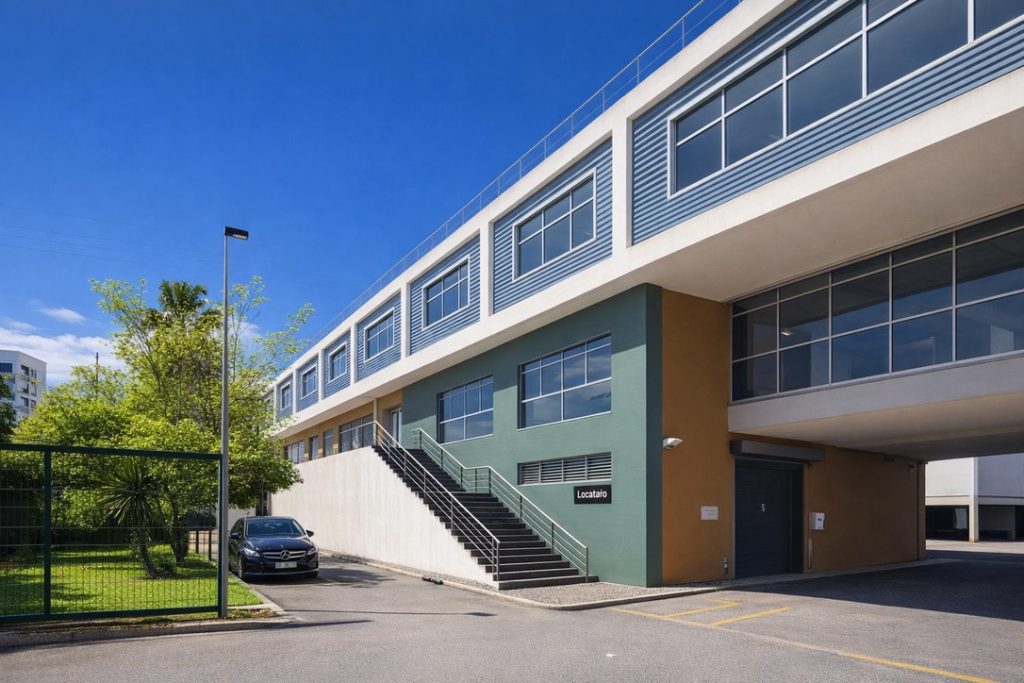
Image source: Alto Business Park I INBRIGHT Portugal

Alto Business Park is strategically located just northwest of Lisbon along the A1 motorway and comprises approximately 16,259 sqm of flexible light industrial space within a well-connected metropolitan industrial and logistics corridor. The asset forms part of a consolidated industrial cluster serving both national and international occupiers. It is organised as a multi-building compound with warehouse, office and parking infrastructure.

Following the joint acquisition one year ago, Patron Capital and INBRIGHT Portugal have implemented a structured asset management strategy focused on ESG-led refurbishment, targeted building upgrades and the long-term repositioning of the asset. The objective is to enhance operational efficiency, improve building quality and create flexible, future-ready space for multi-tenant use while strengthening long-term occupancy stability.

Recent leasing activity further confirms this trajectory. Alongside the newly signed 15-year lease with the public sector entity, three existing tenants, Block Control, FDS Beauty and JB Material Sanitário have extended their leases, underlining strong tenant retention and stable occupancy across the park.

The JV between Patron Capital and INBRIGHT is building dedicated investment platforms in both Portugal and Germany with a combined focus on light industrial and last-mile-logistics transformation. The portfolio strategy targets EUR 100 million in Portugal and more than EUR 500 million in Germany. Across both markets, the strategy is consistent: acquire well-located existing assets, reposition them through ESG and Capex measures, and create resilient, long-term investment platforms based on active asset management.

Jonatas Szkurnik, Senior Partner and Investment Director at Patron Capital, said: “Portugal continues to stand out as one of the most attractive investment markets in Europe, supported by strong economic fundamentals and compelling opportunities within the existing real estate stock. Alto Business Park is a good example of the type of asset we seek to invest in: well-located, operationally resilient and offering significant potential for long-term value creation through active management.“

Christoph Gumlich, Managing Partner at INBRIGHT Portugal, said: “We are pleased to have secured this new long-term agreement at Alto Business Park, reinforcing the continued execution of our asset management strategy on site. The agreement reflects the effectiveness of our structured approach to upgrading the property and implementing targeted ESG measures. At INBRIGHT, we actively drive asset performance through hands-on property and asset management—translating evolving occupier requirements into concrete, value-enhancing improvements and a future-proof positioning of the asset.”


Your media contact

Yvonne Hoberg
GLOWING MIND | Communications & Transformation

M +49 151 54 750 169
presse@inbright.de

Our Contribution to the sustainable Development Goals of the United Nations

The 17 Sustainable Development Goals (SDGs) were adopted in 2015 by the member states of the United Nations.
They set a road map for the sustainable social, economic and environmental transformation of our world by 2030.

The SDGs also offer us as a company a framework for contributing to a positive future for the world. Our ESG strategy is our contribution to tackling the greatest worldwide challenges, especially to achieving the following SDGs:

We respect diversity, a fair pay and participation structure and the indivdual promotion of out team members, thus contributing to equality of opportunity.

Economic success and a profitable investment strategy are for us the foundation for securing attractive jobs in the long term and contributing to healthy economic growth.

We promote a low-emission infrastructure by locating our properties close to existing residential areas, offering our tenants access to public transport. We modernise and reposition old industrial and commercial properties to make their use lower in emissions, cleaner and more flexible, thus making a noticeable contribution to sustainable industry.

When building and repairing our properties, we are careful to use innovative and engery-efficient systems so as to aviod unnecessary environmental pressures on the surrounding area. Wherever compatible with legislation and the comfort demands of our users, we reduce technical equipment to a minimum to promote the longevity of our properties.

We align both our company and our property projects to ESG criteria. This includes planning our properties in a way that is sparing of resources and ensures them a long useful life with maximum flexibility. We also maintain open interactions in the spirit of partnership with all those involved – from planners and building firms through to the eventual user.

Reducing emissions, especially CO2 emissions, has a high priority for us within our ESG strategy. We as a company aim to reduce and compensate for our CO2 footprint to make the most effective contribution we can to protecting the climate.

How we derived Our ESG strategy

In an initial workshop, we first developed core values for our company. The development of an ESG strategy for INBRIGHT is based on this: main topics were determined and validated based on a fixed evaluation scheme in a two-day workshop. On the one hand, the topics result from the requirements of national and international industry standards and frameworks, such as DGNB, LEED and GRESB, and, on the other hand, from general sustainability standards, such as the Global Reporting Initiative (GRI), the Sustainability Accounting Standards Board (SASB) and the Sustainable Development Goals. The list of topics was ultimately supplemented by specific industry requirements from the Light Industrial area. The collection of topics was classified based on a fixed evaluation scheme in a materiality assessment using a two-dimensional matrix with the dimensions “Relevance to business” and “Effects on the government and society”. The topics with the highest values in both dimensions, and hence being above the materiality threshold, form the basis of our ESG strategy or our sustainability programme. The materiality assessment is revalidated annually with the participation of internal and external stakeholders and the assessment of the topics is adjusted accordingly. 

Our Contribution to the sustainable Development Goals of the United Nations

The 17 Sustainable Development Goals (SDGs) were adopted in 2015 by the member states of the United Nations.
They set a road map for the sustainable social, economic and environmental transformation of our world by 2030.

The SDGs also offer us as a company a framework for contributing to a positive future for the world. Our ESG strategy is our contribution to tackling the greatest worldwide challenges, especially to achieving the following SDGs:

We respect diversity, a fair pay and participation structure and the indivdual promotion of out team members, thus contributing to equality of opportunity.

Economic success and a profitable investment strategy are for us the foundation for securing attractive jobs in the long term and contributing to healthy economic growth.

We promote a low-emission infrastructure by locating our properties close to existing residential areas, offering our tenants access to public transport. We modernise and reposition old industrial and commercial properties to make their use lower in emissions, cleaner and more flexible, thus making a noticeable contribution to sustainable industry.

When building and repairing our properties, we are careful to use innovative and engery-efficient systems so as to aviod unnecessary environmental pressures on the surrounding area. Wherever compatible with legislation and the comfort demands of our users, we reduce technical equipment to a minimum to promote the longevity of our properties.

We align both our company and our property projects to ESG criteria. This includes planning our properties in a way that is sparing of resources and ensures them a long useful life with maximum flexibility. We also maintain open interactions in the spirit of partnership with all those involved – from planners and building firms through to the eventual user.

Reducing emissions, especially CO2 emissions, has a high priority for us within our ESG strategy. We as a company aim to reduce and compensate for our CO2 footprint to make the most effective contribution we can to protecting the climate.